“Archery’s Greatest
Improvement”
Howard Hill
Howard Hill

Shakespeare Parabow
Solid Fiberglass Bows
by
Larry Vienneau
Solid Fiberglass bows can’t really be compared to wood core and laminated recurves and longbows or the contemporary compound bow. Today’s archers tend to forget that these simple self-bows were one of the most important part in the development of modern archery. Aspiring young Robin Hoods honed their skills with solid fiberglass bows. From the early 1950s though the late 1970s millions of tough fiberglass longbows and recurves were mass produced by archery manufacturers like Indian, Herter's, Paul Bunyan, Ben Pearson, Bear, Ply-Flex, Stream-Eze, Outers, Stemmler, Lockleys, York, Fleetwood, Zeus, and of course Parabow and Shakespeare..


William
Shakespeare, Jr. invented a patent for his fishing reel, and began producing
fishing equipment in the late 1800's. In the 20th century
Shakespeare became a major producer of sporting equipment. In 1959 Shakespeare Cooperation
acquiring Parabow the Ohio-based Parallel Products Company, a maker of archery
equipment that was organized into Shakespeare's Archery subsidiary. Parabow was
one of the main producers of solid fiberglass bows in the 1950. Shakespeare was
an early pioneer of the application of fiberglass to fishing rods. The merger
of these two companies was a match made in heaven. During the sixties and
seventies Shakespeare produce fiberglass and wood laminate bow but it did not
forsake its Parabow line of solid fiberglass archery equipment.
The 1950’s was
the time of Happy Days, Twinkies, Howdy Dowdy and mass production. Literally
Millions of solid fiberglass bow were produced. Parabows, like all solid
fiberglass bows, don’t have the smoothness and speed of wood and fiber glass laminate
bows and heaver bows are prone to stacking. However there are some very positive
features to these bows:
Expense: The
cost of a solid fiberglass bow has always been much lower than laminated constructed
equipment. For the beginner, or budget archer, the simple one piece, mass
produced design is easy choice. Kids are rough on bows, and it makes sense to
buy inexpensive equipment while they are learning. Used solid fiberglass bows are plentiful and
can often be purchased at a yard sale or on E-bay for a few dollars. Value is dependent on condition, draw weight, and manufacturer. BEAR and BEN PEARSON fiberglass bows are the most common. Others are scarcer. Prices vary from $25-$75, Rare bows can go as high as $125. Sometimes complete sets are available, some are mint in the box. Mint means un-used. These sets can be priced as high as $300 but you need to look at the condition and research the sets to see if it is authentic. There is a fiberglass bow on eBay now being sold as rare antique and they are asking $598!!
 It is not a rare bow, it is a Ben Pearson youth bow missing its decals. it should be priced at about $35. Buy wisely, do your research, and ask questions

Resilience: Fiberglass bows can be slogged through
snow, shot in the rain, dropped in mud, left outside in the wet ground
overnight; the bow is will not delaminate. Fiberglass bows have little danger
of being over drawn. They can be left strung for long periods of time without
fear of the limbs following the string, they nearly indestructible and ideal for
bowfishing, hunting, canoeing or boating. If you want to purchase a more powerful model you
are restricted to the used market because heaver bows are not made today. Always
check for cracks and hairline splits in the glass, as well as twisted limbs
before buying.
Efficiency:
A solid fiberglass bow is not as efficient at casting an arrow as well as a
built laminated recurve and longbow. Despite this fiberglass bows are lethal;
many trophy animals have been harvested with them. The main problem is the
narrow limb design which tends to cause stacking in heaver bows. If you chose
to use a fiberglass bow for hunting deer, add an extra 5-10 pounds to
compensate for the slower cast. My B7 Comet 45 lb. shoots at 158.27 FPS while
most of my other 45 lb. recurves are between 170-184 FPS
 | |
| Shakespeare Parabow #50 RH Brushmaster (Thanks to Lewis Kent), #45 Model B-7 Comet, #18 Model B-9 Fury |
 |
| Early Shakespeare Parabow Sharpshooter Longbow 40 lbs. with a Waverly Ohio tag |
I think everyone
has memories of these humble bows. My memories are of shooting them in camp as
a child and using them when I was a late teen to target shoot. The most moving
memory was when I found a 50 pound Shakespeare Parabow Brushmaster leaning
against a tree while I was moose hunting in Alaska; it rested there undisturbed
where a hunter had placed it over forty years before, waiting for me to come
along to find it. I
have had many debates with folks in traditional archery forums who fail
to recognize the contribution that the humble Fiberglass has made to
American archery.
 |
| Chris Libby with son Clint |
Chris Libby wrote a much more in depth article on solid
fiberglass for Traditional Bowhunter "Ayuh…Fiberglass!" (http://www.tradbow.com/public/272.cfm)
In his article his last paragraph brilliantly places the Solid Fiberglass Bow
into its rightful place in modern archery.
“Dismiss my affection for "self bows" made of
fiberglass, as nostalgia, and the bows themselves as children's toys and mere
junk, if you will. However the fact remains that these bows are as much a part
of the history and culture of archery during the last century, as are Howard
Hill's bamboo longbows and Fred Bear's Kodiak recurves. If it wasn't for the
solid fiberglass bow, millions of people wouldn't ever have known the feeling
of standing under a blue sky in the warm summer sun, and watching an arrow arch
in its mystical path toward the target. Given the importance and overall usefulness
of this basic but deadly introductory weapon to our sport, as far as I'm
concerned I'll agree with my Grandfather; "Ayuh…Fiberglass!" “
Parabow
by Shakespeare
B-1
Hunter Shakespeare 1960-68
- Charcoal color fiberglass
- Leather grip
- Shaped static nocks
- 55” 51” string
- Draw: 35#-65# 1960-61, 35#-55 1962, 35#-60# 1963-68
- RH only
- 6 ½ brace
B-2
BrushMaster 1960-62
B-1
C 1964-70
- Charcoal fiberglass
- Leather grip
- Shaped static nocks
- 63” 60” string 1960-62
- 55” 1964-70
- Draw: 35#-65#1960-62, 45# 1965, 40-50# 1966-70
- RH only
- 6 3/4" brace
B-3
Sharpshooter 1960-65
- Red Black finished fiberglass, Red 1962-65
- Mottled gray grip 1960, white pistol 1962,63
- 60”-57” string
- RH LH 1960-61
- RH 1962-65
- Draw: 20#-40#
- 7” brace
B-4
Robin 1960-62
- Red and black finish 60-61, red 1962
- White plastic grip
- White nocks
- RH LH
- 54” 50” string
- Draw: 20#
- 6" brace
B-6
Marksman 1960-62
- Brown white mottled fiberglass 1960
- White plastic grip, brown 1960
- White tips 1961, 62 brown
- 58" 55" string
- RH LH
- 25#—50#
- 6 3/4 brace
B-7
Comet 1960-62
- Brown and white molted fiberglass, , two tone brown 1961, forest brown 1962
- White plastic grip 1960, Brown 1961,62
- 56” 53” string
- RH LH
- Draw: #40-#55 1960, 35-55# 1961
- 6 1/2 brace
B-8
Rocket 1960-75
- Red finished fiberglass 60-61, green 62-68
- White handle, wt. pistol grip 1962-75
- 56” 53 ½” string
- RH LH 1960-61, 1965-75
- RH 1962-64
- Draw: 25-35# 1960-61, 20-45# 1963-77
- 6 ½ brace
B-9
Fury 1960-75
- Red Yellow or green fiberglass 60-61, red or green 1962,
- White handle
- 50” 46” string
- 6” brace
- RH LH
- draw: 18#
B-10
Will Scarlet 1960-65
- Red finish fiberglass
- White handle and nocks
- 48” 41 1/2“string
- RH LH
- draw: 12#
- 5” brace
B-11,
1962,63
- Fiberglass gold finish
- Pistol grip black, 6’ sight window
- 66”
- draw: 20#-50#, #30-50# 1963
- RH
- 7 “ brace height
B-12,
1962-63,
OmniBow
1964- 67
- Fiberglass copper finish
- Pistol grip black, 6’ sight window
- 64”
- Draw: 20#-50# 1962, 20-55# 1963-,67
- RH
- 7 “ brace height
Here are some beauty shots of George Stout's Parabow. Looks like he had a great day!!!

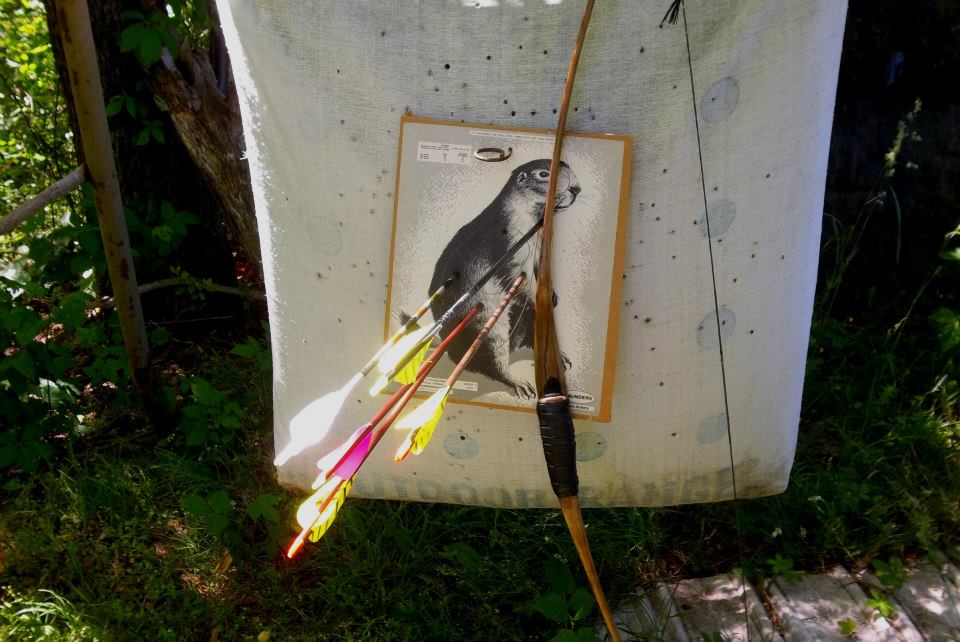

Thank you George
© Copyright, Larry Vienneau Jr.
All rights reserved.


